
Since the Australian Constitution took effect in 1901, there have been 44 referendums to make constitutional amendments with only 8 being successful. The Voice to Parliament vote on October 14 will be the country’s first referendum since 1999, with Australians being asked to vote “Yes” or “No” on the following amendment:
A Proposed Law: to alter the Constitution to recognize the First Peoples of Australia by establishing an Aboriginal and Torres Strait Islander Voice.
Do you approve this alteration?

What is the Voice?
The Voice is a proposed Australian federal advisory body comprising of Aboriginal and Torres Strait Islander people who would advise Parliament and Government on matters affecting Indigenous communities. The Minister for Indigenous Australians, Linda Burney, has said she will ask the Voice to prioritize Indigenous housing, health, jobs and education.
Conservative critics have raised fears the Voice could encourage court challenges, but a majority of high-level constitutional lawyers have all either spoken strongly in support of the voice or dismissed concerns about the legal effect of its representations.
Educating ourselves about the issues
AWNY is providing a background on the issues surrounding the referendum for our members who may be casting a postal or in-person vote at the New York Consulate-General, or are enjoying engaging in conversations with family and friends here in New York or back home. We’re also sharing some opposing opinions below about the Voice from members of our community, which we hope will help serve as a guide in your decision making process:
- NO vote – Dr Victoria Grieves Williams, Indigenous Warraimaay historian, CEO of Ngarrang Marrambu Ltd., creative producer of new content for documentaries and dramas.
- YES vote – Ann-Marie Everitt, New York for Yes! campaign organizer, yoga teacher and educator at AMBA Yoga, and a community advocate for climate and social justice.
Find out more about how and where to vote

It’s not compulsory to enrol and vote when you are outside Australia, but a vote is an extremely valuable thing to have so if you’re keen to have a say on this issue, visit the Australian Electoral Commission’s Referendum 2023 for details about your eligibility and voting overseas.
The Australian Consulate-General in New York located at 150 E 42nd Street will offer in-person voting from Monday, 2 October 2023 to Friday, 13 October 2023 (excluding the weekend) from 9:00am to 5:00pm. Eligible voters can also return their completed postal votes via local mail or drop-off. Remember to take your photo ID to gain entry.
A helpful reading list
What can you do to be informed? Here’s a link from the ABC to help you out, or take a look into the reading list below:
- City of Sydney: Voice to Parliament Referendum
- National Library of Australia: Voice to Parliament handbook
- University of Sydney: Voices on the Voice – Noel Pearson
- Noel Pearson reflects on “Who we were and who we can be” in his 2022 Boyer Lecture
- Indigenous people opposing the Voice Reuters article
- More voters intend to vote No, essential poll finds Guardian Article
- Nyunggai Warren Mundine AO – The Nature of the Beast – Mundine’s Voice Series
- Henry Ergas – Talmudic sages gave lessons in equality for all citizens
Whatever your position, put some time in the calendar to do your research and then put some more time aside to talk with families and friends about this important moment in Australia’s history.
Supporting the YES vote
Ann-Marie Everitt is a Brooklyn-based Australian, a New York for Yes! campaign organizer, a yoga teacher/educator at AMBA Yoga, and community advocate for climate and social justice. Here is her message to AWNY members:
Dearest AWNY friends and members,
Let’s dive into one of the most important discussions echoing across Australia right now: the Indigenous Voice and the 2023 referendum on October 14. As we come together as a community, let’s ensure we understand the nuances, listen to multiple perspectives, and contribute to a rich dialogue that shapes our nation’s future.
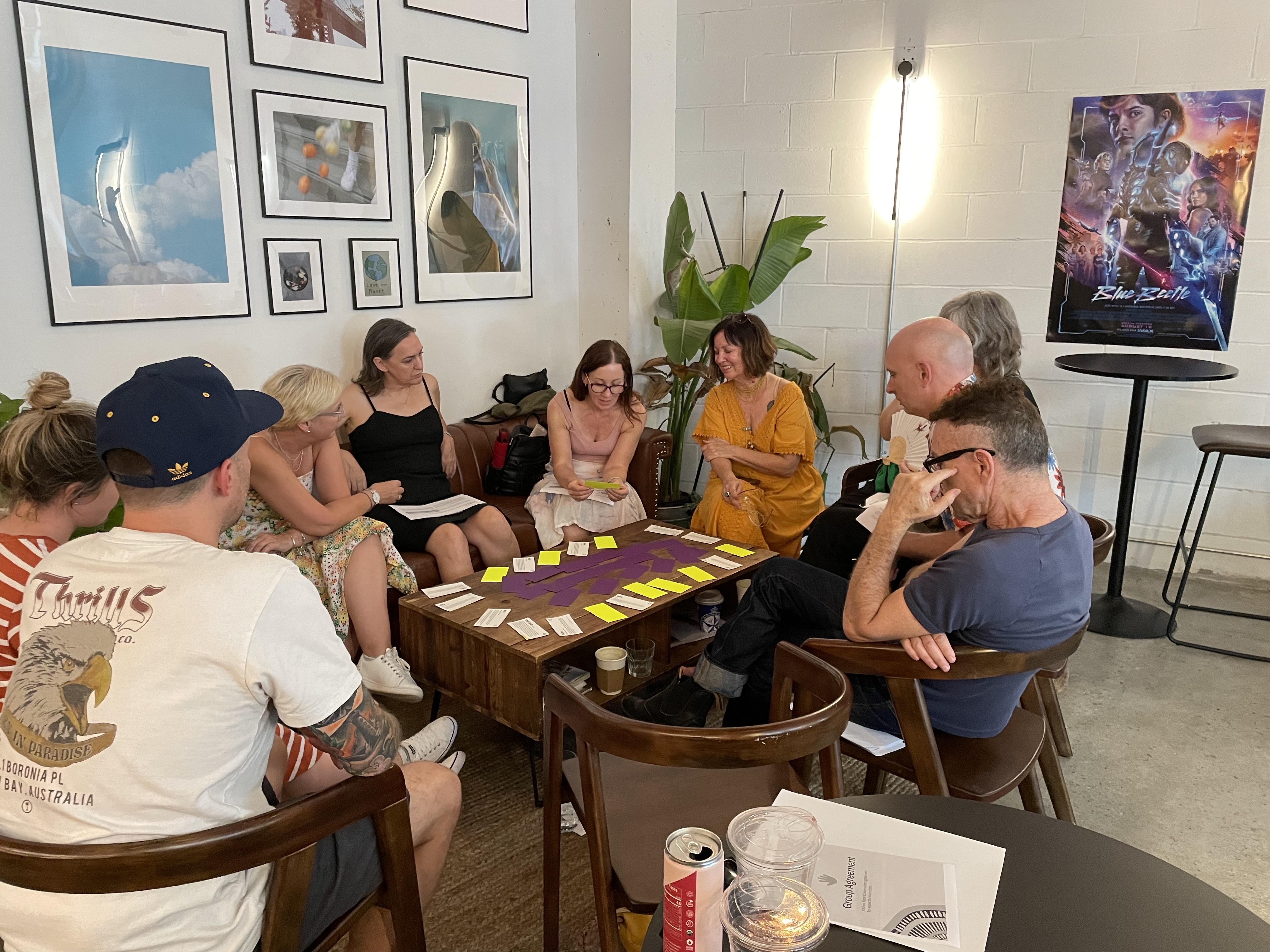
In this vibrant tapestry of opinions, it’s important to acknowledge that not everyone will agree, and that’s totally okay. Did you know that around 80% of Aboriginal and Torres Strait Islanders do support the Indigenous Voice? It’s a powerful testament to the significance of this proposal.
Outside of this support two debates are simmering: one pondering if the Voice goes too far, and another, including those of the Blak Sovereign Movement, questioning if it goes far enough. These diverse opinions deserve our attention and respect, they enrich our conversations.
Aboriginal communities are strong and capable, rich in culture and knowledge and they have extended an invitation to all Australians through the Uluru Statement of the Heart to walk with them to a fair and equitable future.
It’s a dialogue that has been long overdue. Australia lags behind other nations when it comes to Indigenous rights and recognition. Countries like Canada and the United States have granted sovereign rights to First Nations people, while countries such as Finland provide indigenous groups their own parliaments. In New Zealand, the Maori people have the Treaty of Waitangi, and Maori seats in parliament.
- If you’re interested in joining the New York Walk for Yes! across Brooklyn Bridge on Saturday, September 16th at 2pm from City Hall Park with fellow Australians, friends, families and loved ones, sign up here.
- If you’d like to help organize or support New York for Yes! campaign events, register here.
- If you’re interested in attending the Yes! Democracy Sausage Sizzle NYC on Friday 10/13, RSVP here.

As the October 14 Referendum approaches, let’s remember that respect knows no boundaries of color, income, or location. This debate isn’t just about the ‘YES’ or ‘NO’ camp—it’s about building support for solutions that First Nations communities have advocated for decades that center healthy families, education and self determination.
Let’s embrace this opportunity to grow together, learn from one another, and pave the way for a more inclusive, respectful, and equitable future.
If you’ve made your decision, be sensitive to where others are at. There’s a lot of unnecessary confusion out there, perhaps you can help them through a foggy place. Keep learning! Our shared cultural space is getting richer and richer.
Ultimately The Voice is designed to be a unifying project about people not politics, and if you’re watching the plethora of referendum centered community events continuously rolling out in Australia and here in New York, you can see it’s already working. People are learning and listening and growing together. There’s a shared vision that’s bringing joy and meaning and hope for the future.
Please bring your voice to the party – vote Yes!
Much love and unity,
[Your Name]
Supporting the NO vote
Dr Victoria Grieves Williams is an Indigenous Historian based in New York, she has been writing opinion pieces for various publications in Australia during the Voice campaign. Here is her message to AWNY members:

Dear fellow travelers in New York! I am an Aboriginal woman, Warraimaay from the midnorth coast of NSW. I have a large Aboriginal family and kin in Australia and I live an Aboriginal life with a very deep experience of Aboriginal issues in Australia over some 40 years of high-level engagement.
I know many of you will think it is counterintuitive for an Aboriginal person to be opposed to the Voice proposal. I don’t want to be only remembered for my opposition to this, because of the tenor of the debate, and because I work in other ways to help to create a united Australia. However, the Voice has become an issue that overwhelms everything else for us as Aboriginal people. If it is introduced I believe this will continue and exacerbate any race divide. I consider myself non-aligned politically. The western politics of the right and left do not assist us as Aboriginal people, our issues need to be non-partisan. The advantages that would accrue from adopting an Indigenous philosophical approach to social and political issues go far beyond anything the right/left divide can provide.
I was one of the original NAEC 1000 Aboriginal teachers by 1990 for example and was on the ground floor with the establishment of Aboriginal Studies curriculum for TAFE and universities. I was part of the team that developed the National Aboriginal Education Policy (NAEP) and programs. I am a highly published activist historian engaged in decolonisation and truth telling. This last week I spoke at the launch of a report by Reconciliation Australia Recognising Community truth-telling: an exploration of local truth-telling in Australia as the chair of the advisory committee to the research project. In this connection I know that ordinary people can work in ways to bring about better relationships through dealing with painful histories. This is happening already in settler colonial contexts in the USA and Canada as well as Australia.
I have published on the need for a shared sovereignty in Australia. The Voice is not about a true reconciliation through sovereignty and since that is the aim of most Aboriginal people I know, it does not measure up. There is no reliable evidence of Aboriginal support, in fact the GetUp! poll indicates that 25% are opposed and 45% hadn’t heard or knew nothing about the Voice.
Broadly speaking the Aboriginal populations in the south-east of Australia have made great strides since the 1967 referendum that resulted in the removal of the segregationalist policies of the states and territories, some faster than others. We punch above our weight in all areas of life, not just sport anymore! Film, theatre, dance, academia, politics, literature, medicine, law I agree with Leah Purcell the wonderfully accomplished actress, director and writer when she said in a recent interview “There’ll never be harmony in Canberra because everyone has an agenda. I put my voice through my stories, just hoping to bring about understanding, along with other Indigenous mob out there”.

I believe the Voice threatens to reintroduce segregation and in a way that can only be cumbersome, bureaucratic and it will not produce the results for Aboriginal people that we need. It will not close the gap. It will continue to exacerbate the divisive racist debate that has now ignited.
The Aboriginal people living in remote Australia who have so much to offer in terms of living well in the country are those in most need. It is frustrating indeed that there has been so little movement in the social indicators for these people over decades of federal government involvement in Aboriginal policy. They need to be placed at the centre of any new directions in Aboriginal policy. The Voice would override the direct relationships they have with governments. This was expressed in no uncertain terms by the Ngaanyatjarra Council in their submission to the Indigenous Voice Co-design Process known as the Calma-Langton Report.
Unfortunately the beginning of the Uluru Statement from the heart has been irretrievably marred by the casual treatment of local anangu who demand the name Uluru be removed from the Uluru Statement from the Heart. They were not included in discussions about the Voice, knew nothing of it, invited only to dance and then their signatures were fraudulently used on the document. This disregard for remote Australia cannot go on and the Voice promises to only continue this with a top-heavy Canberra-based bureaucratic model.
I have discussed this proposal with native American friends who are mystified, they say that while they have problems with the treaties they would not want to be homogenised into one group as an advisory – they prefer to keep their autonomous relationship with the government through their Federal Tribal Registrations. My Canadian native friends are still seeking a shared sovereignty. There is no push for an advisory to government in the same way as the Voice. All my friends would hesitate to say that they have a perfect relationship with the state, they have their myriad complexities as we do, it is a work in progress.
There are many well-meaning Australians who just want to do something to improve the lives of Aboriginal Australians. I appreciate you immensely but so many well-meaning people do not know about the reality of Aboriginal affairs, the diversity and the power differential that exists amongst us. The Voice is not the answer, it is more of the same. And if nothing changes, nothing changes. We need to address the disadvantage of Aboriginal Australians in ways radically different to current and past practices.
There is a great deal of work to be done and can best be done through relationships and philanthropy. Reach out to Aboriginal people, find out, lend a hand. We need many more discussions, much more activism, to get us to a point of sharing sovereignty.
I ask that you vote No.
Warm best wishes
Victoria
CEO and Founder, Ngarrang Marrambu Media
Working toward Healing Histories
Stay connected with AWNY
Register for our monthly newsletter and be kept in the loop for our upcoming events, where you can meet like-minded Aussie women living and working in New York.
Blog – https://australianwomeninnewyork.org
Facebook – https://www.facebook.com/AUWomenNYC/
Twitter – https://twitter.com/AUWomenNYC
Instagram – https://www.instagram.com/auwomennyc/
Questions? Please email AWNY (awny@aaanyc.org).

 AWNY | Australian Women in New York