
“Will you be mine, Saint Valentine” and “We are going on a picnic!” have been looping in
my head ever since seeing Picnic at Hanging Rock: The Musical last Monday night at
Greenwich House Theater, surrounded by a large group of Australian Women in New
York (AWNY) members and friends. Not the kind of earworms you want to escape, but
songs I’ve been joyfully singing throughout the holidays. In my view, leaving a theater
with melodies lingering in your mind is always a promising sign.
AWNY attended the performance on Monday, 22 December, and we were proud to
gather such a strong turnout at an especially busy time of year. Following the show, we
were fortunate to participate in a talkback with composer Greta Gertler Gold and
several cast members, including AWNY member Kaye Tuckerman, who delivers a
commanding performance as the enigmatic Miss McCraw. The discussion offered
insight into the work’s development, its musical language, and the challenges of
bringing this iconic Australian story to the stage.
Based on Joan Lindsay’s novel Picnic at Hanging Rock, the musical draws inspiration
from Peter Weir’s 1975 film adaptation while forging its own theatrical identity. Notably,
it weaves in references to Australian First Nations culture and acknowledges the
cultural and spiritual significance of Hanging Rock—known as Ngannelong—adding
further depth to an already haunting narrative.
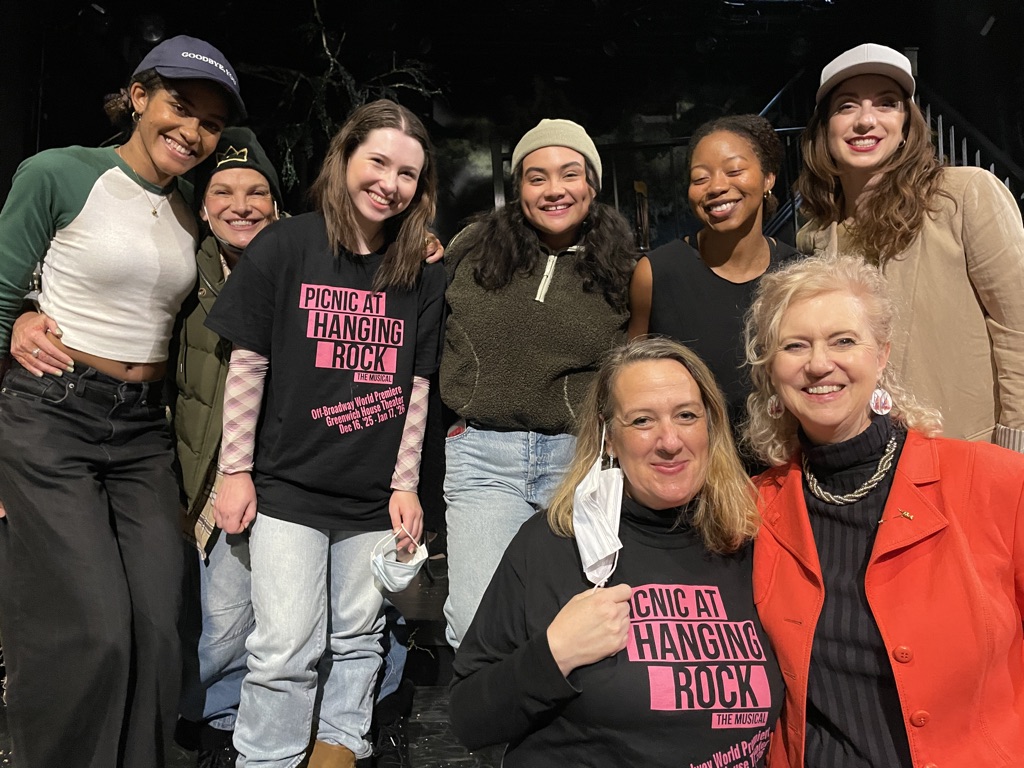
At the talkback after the performance of Picnic at Hanging Rock, The Musical on December 22nd. Back row – L to R: Jordan White, Kaye Tuckerman, Carly Gendell, Tatianna Cordoba, Kate Louissaint, Sarah Ellis, Front row: Greta Gertler Gold and BJ Jackson. Photo credit: BJ Jackson
The story unfolds in 1900, pre-Federation, when Australia was still a British colony.
Appleyard College, a rigidly British boarding school for upper-class girls, is preparing for
a Valentine’s Day picnic at Hanging Rock, a leisure spot in rural Victoria. What begins as
an innocent excursion becomes a mystery when three girls and a teacher fail to return.
From this moment onward, time itself becomes unsettled.
Time is a persistent motif throughout the musical. Clocks stop at noon; a metronome clicks relentlessly during piano practice; unseen clocks tick away in the Head Mistress’s office—perhaps a grandfather clock, looming but never revealed. These sonic and visual cues heighten the sense of inevitability and unease. Like the novel and film, the musical resists resolution. Some audience members may find the lack of answers frustrating, but I found it compelling and provocative. Did they slip into another realm? Reject the paths laid out for them? The unanswered questions invite reflection long after the curtain falls. The show closes with another memorable song, ‘Time and Place’, that states “We’re here and we’re gone”, leaving us to question: how long do we have, and how do we make the most of the moment we share?
Rather than telling the story chronologically, the musical unfolds in a series of
impressionistic scenes that gradually reveal relationships and inner lives. Miranda, the
school’s golden girl, is admired by all. She befriends Sara, an orphan sponsored by an
unknown benefactor, who finds safety and belonging in Miranda’s presence. Their bond
forms the emotional heart of the piece. The other girls are equally vivid. Irma, from a wealthy family, is destined for England, where she will make her debut and secure a suitable husband. Marion, intellectually gifted and ambitious, dreams of becoming a judge, yet is resigned to the fact that society will likely confine her to life as a judge’s wife. Miranda herself seems to embody
freedom and possibility—graceful, elusive, and quietly resistant to the limits imposed
upon her.
Love, in its many forms, is a central theme throughout the story: the love of life, the love
of friendship, love unfulfilled, and love for the unknown. It captures the intensity of
teenagers finding their first best friend, the hope bound up in imagined futures, and the
desire that emerges when one dares to dream beyond expectation.
Greenwich House Theater (formerly the Barrow Street Theater) presents an intimate
challenge for a musical of this scale, but the production rises to meet it. The
choreography makes inventive use of every inch of the space. A two-level set suggests
the imposing structure of the school, while the musicians are integrated seamlessly
onstage beneath a school tower. At times, the performers move through and around the
audience, evoking the expansiveness of the Australian bush. Sound design
incorporates native Victorian bird calls—whipbirds, crows, and currawongs—a detail
that many Australians in the audience instantly recognized and appreciated. Thoughtful
lighting design guides us fluidly through shifts in time, place, and mood.
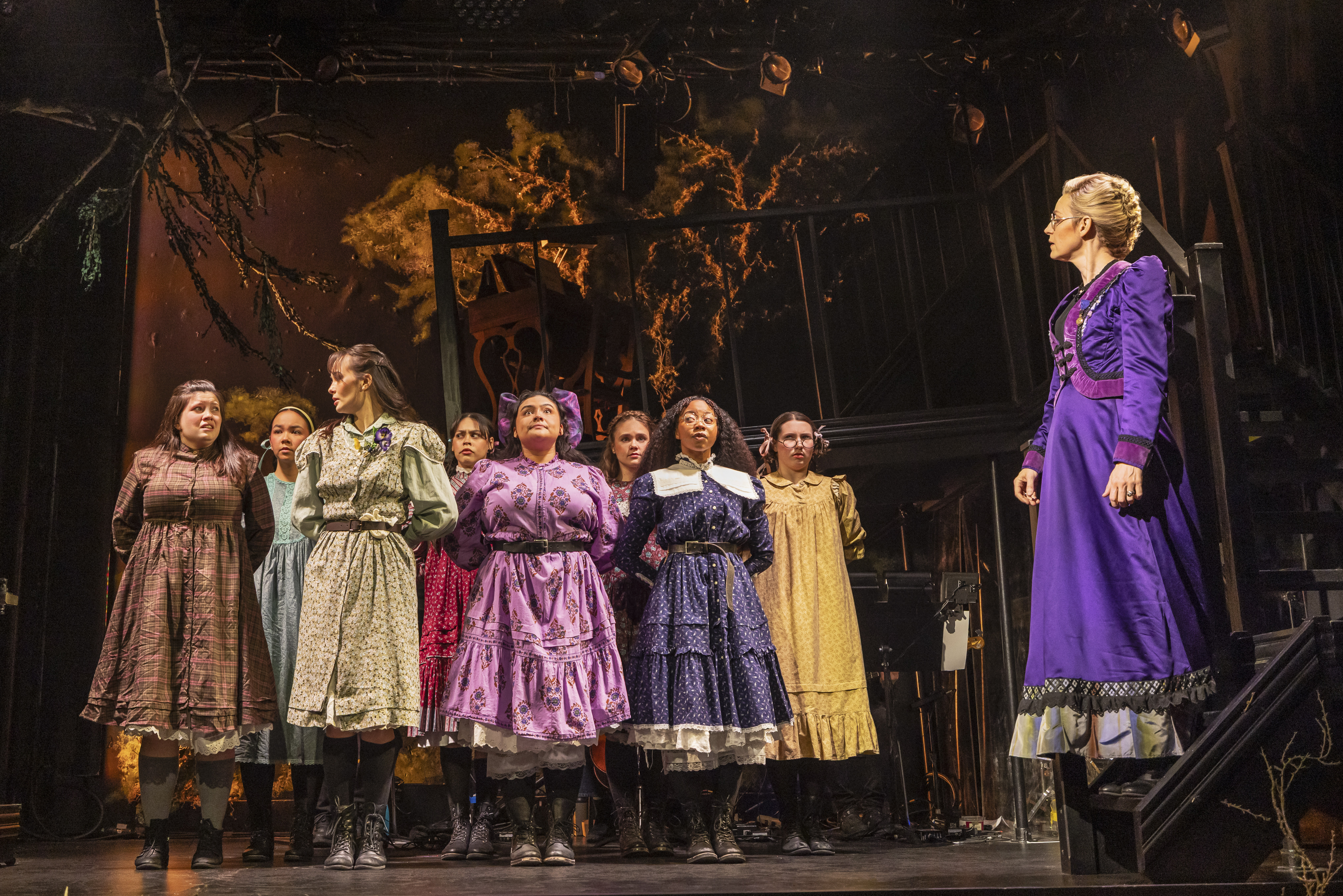
Mrs. Appleyard with the girls at Appleyard College. Photo credit: Matt Murphy
The production also uses accent and voice with remarkable precision. Mrs. Appleyard
and Michael, nephew of the local landowner, speak in strict British accents, reinforcing
authority, colonial power, and emotional distance. The schoolgirls adopt upper-class
Australian accents, reflecting their education and social positioning, while Albert and
Sarah speak with broader Australian tones, subtly underscoring class, access, and
belonging. These vocal distinctions deepen the storytelling and add another layer of
authenticity for those familiar with Australian social history.
The design elements—set, choreography, and music—invite the audience to imagine
rather than be shown. We see the girls climbing through the rock’s crevices, ducking beneath branches, and drifting away from the known world through physical storytelling and gesture.
There are two men in the cast: aristocratic Michael, and Albert (Bertie), an Aboriginal
tracker engaged to show him around his uncle’s property. Their presence underscores the colonial dynamics at play and offers a counterpoint to the sheltered world of Appleyard College, while also raising questions about power, belonging, and perspective.
Musically, the score is sublime and richly textured, with echoes of opera, Philip Glass–
like minimalism, and moments that recall Kate Bush’s ethereal storytelling. One number even flirts with ragtime. The costumes beautifully evoke turn-of-the-century Australia, grounding the production firmly in its period while allowing the story’s themes to resonate beyond it.
When AWNY attended, the production had faced significant challenges: several performances over the preceding weekend had been cancelled due to illness. On the night we attended, three swings and one understudy were onstage—an extraordinary feat for a cast of thirteen, meaning nearly 30% of the company was stepping into alternate roles. Their performances were seamless. As audience members, none of us would have guessed that these artists were not the original creators of their roles.
Picnic at Hanging Rock: The Musical has already attracted attention from major outlets, including The New York Times, and it’s easy to see why. This world premiere is atmospheric, musically daring, and emotionally resonant—a rare piece that trusts its audience to sit with mystery rather than demand answers.
Use our special discount code to see Picnic at Hanging Rock in season, from Tuesday, December 16, 2025, through Saturday, January 17, 2026. Book here using code ROCK25 for 25% off tickets (tickets starting at $45).
For information on how to support further productions of Picnic at Hanging Rock in the USA, Australia and beyond, please contact Greta at gretagertler@gmail.com .
Full disclosure: I am an Associate Producer on this production.
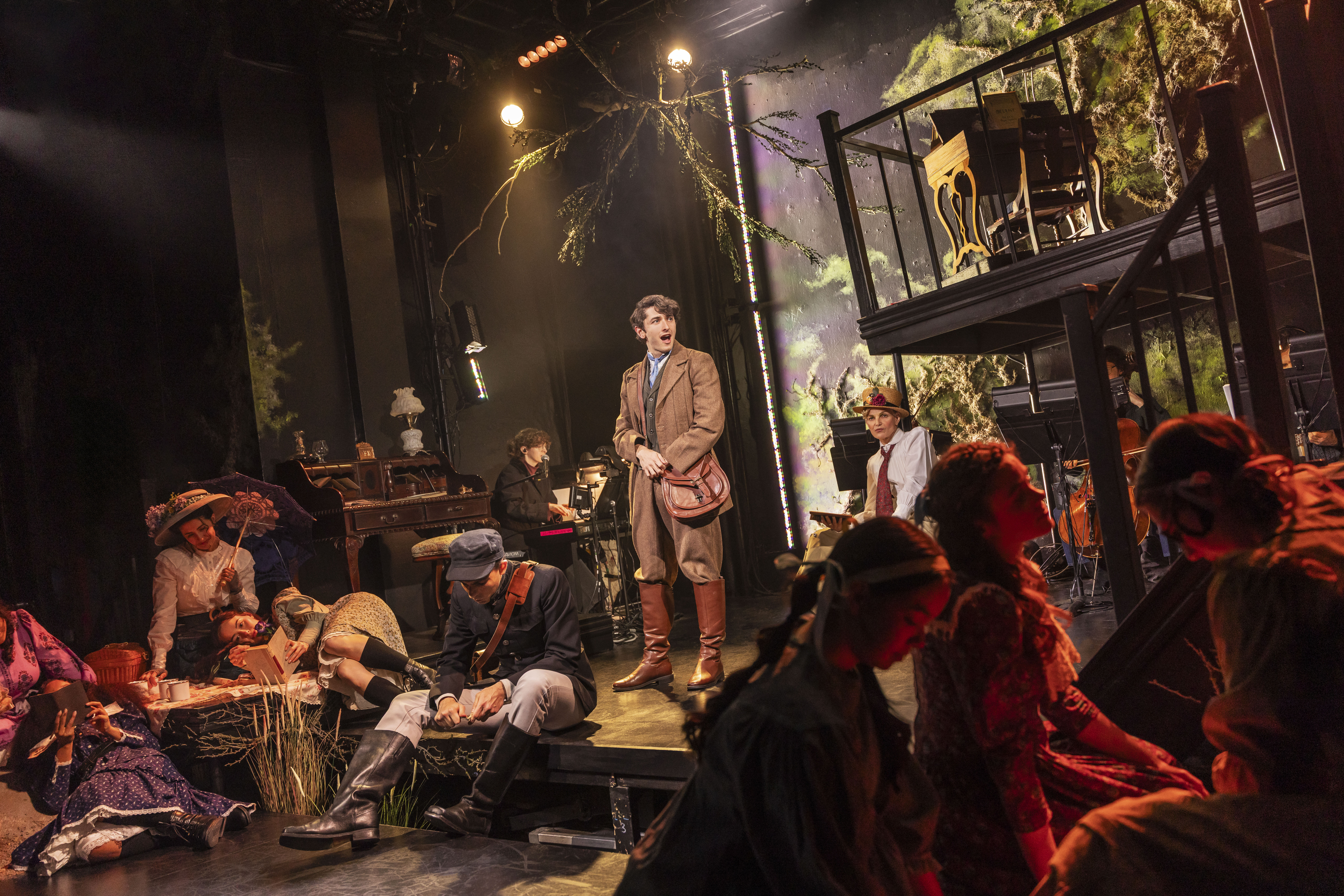
Photo credit: Matt Murphy – Reese Sebastian Diaz as Michael the Aristocratic landowner.
 AWNY | Australian Women in New York