
When Chanel Contos posted a poll on Instagram in February 2021 asking Australian women to share their stories of sexual assault, she expected maybe 30 responses. She got thousands.
What happened next transformed not just consent education in Australia, but Chanel herself, from a young Aussie woman living in London into one of Australia’s most influential advocates for change.
Please note: This article contains discussions of sexual assault and sexual violence and may be sensitive for some readers. If you or someone you know needs support, resources are available through RAINN (1-800-656-4673) in the United States, or 1800RESPECT (1800 737 732) in Australia.
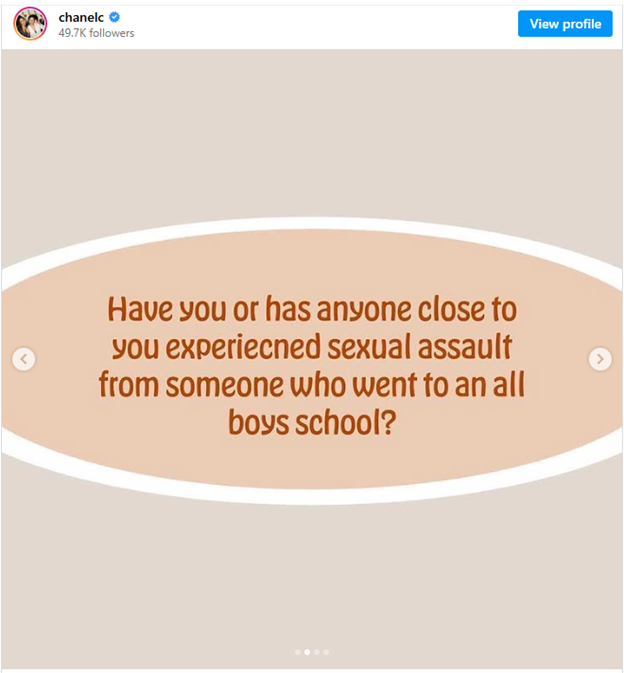
Now aged 26 with a Master of Arts in Education, Gender and International Development from the University College London, and a Master of Public Policy from Oxford University, Chanel has just launched her first book, “Consent Laid Bare” in the United States through Harper Collins.
During a recent conversation in New York, she reflected on her journey from that pivotal Instagram post to meeting with the Prime Minister of Australia to advocate for change in the education system, and what’s next for the movement she never intended to start.
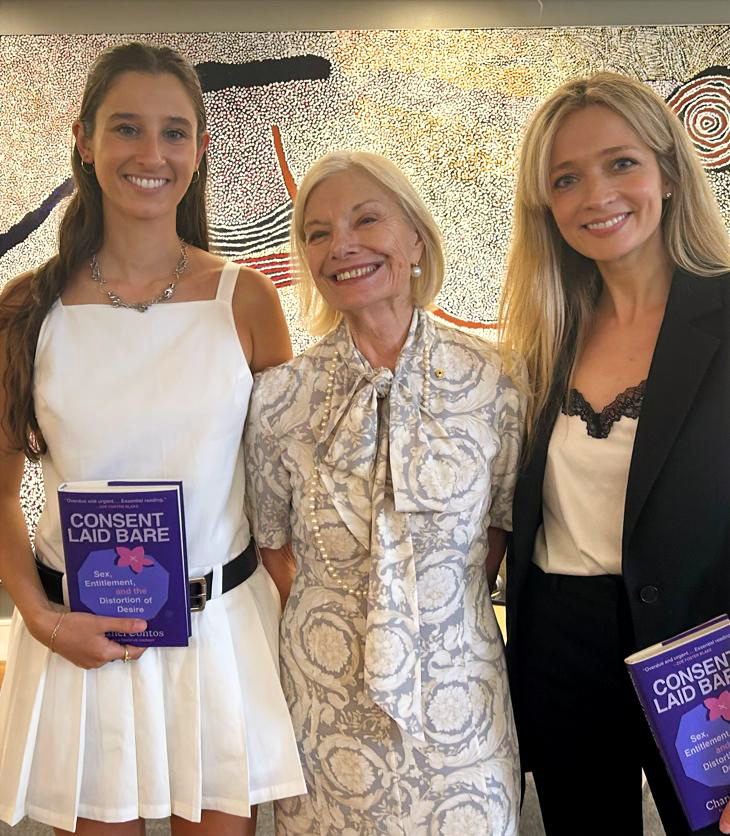
Photo by: Australian Consulate-General New York
The Unexpected Power of Ordinary Stories
Growing up in Sydney’s eastern suburbs within the Greek community, Chanel was acutely aware of strict gender norms and expectations. “I think a lot of the themes I talk about in the book—strict gender norms, patriarchy, what a ‘good girl’ is—were really heightened in that environment,” she explains. The injustice she witnessed around these cultural differences sparked what she calls “an appetite for justice.”
But it was her own experience of sexual assault as a teenager—an experience she describes as shockingly “mundane”—that ultimately shaped her approach to advocacy. “It was never about the fact that it happened to me. It was about the fact that it happened to all of us,” Chanel says. “My experience was just so common and so unremarkable that that’s why it was so noteworthy.”
This focus on normalized sexual violence became the cornerstone of Teach Us Consent–an organization Chanel formed to dismantle rape culture and create a world free from sexual violence through the education of young people.
Unlike awareness campaigns that highlight extreme cases, Chanel deliberately centered on everyday experiences that many women dismiss or minimize. “Even if you’ve never experienced sexual assault, this book is still something that’s going to bring a lot of clarity to you and help you see the world better,” she notes.
It’s Not Just Physical
According to the US Centers for Disease Control and Prevention (CDC), sexual violence is defined as “sexual activity when consent is not obtained or freely given,” including “posting or sharing sexual pictures of someone without their consent, or non-consensual sexting.”
The Australian Institute of Health and Welfare notes that “sexual violence can take many forms, including assault, abuse and harassment. Experiences vary across population groups and in different settings, and there can be long-term physical, psychological, financial, legal, and spiritual consequences for individuals and communities.”
Victims, predominantly women, often remain silent about their experiences with sexual violence because in most cases the perpetrator is someone they know–a friend, partner, coworker, relative, neighbor, or someone in their social circle. Victims may feel embarrassed and blame themselves, feel shocked and want to forget the event, or feel threatened or traumatized.
However different the individual stories and emotional responses, there is power in shared experience. Unity in sharing can bring validation, relief from loneliness and shame, and a sense of belonging.
In Australia, “14% of people aged 18 years and over in 2021-22 had experienced sexual violence since the age of 15.” Australian Institute of Health and Welfare
In the US, “over half of women and almost one in three men have experienced sexual violence involving physical contact during their lifetimes.” CDC
From London Lockdown to National Spotlight
The timing of Chanel’s Instagram poll, in retrospect, was perfect. Posted during England’s third national COVID-19 lockdown in February 2021, it coincided with a national conversation in Australia about sexual violence. Grace Tame had been named Australian of the Year, and Brittany Higgins had just gone public with her story of assault in Parliament House, though Chanel was largely unaware of this broader context at the time.
The surge of digital communications during the pandemic and heightened awareness around the topic proved crucial to the success of the Teach Us Consent campaign. Within weeks, what started as a small poll had generated over 7,000 responses (though fewer were published due to defamation concerns) and a petition with 50,000 signatures calling for consent education to be included in the Australian school curriculum.
Without a budget to process all the stories, Chanel recruited law students in Australia to help navigate defamation laws and volunteers to de-identify stories. Chanel acknowledges that running the project from London provided emotional distance from potential social repercussions as details of the personal stories came to light, including the names of perpetrators, some of whom Chanel knew. “I didn’t have to run into these boys or their families.”
“It is just as much an injustice to boys that our education system has failed them. How can we blame children for being the products of an environment that reinforces this behavior?”
CHANEL CONTOS, Consent laid bare
Navigating Politics with Youthful Confidence
Perhaps most remarkably, Chanel found herself in meetings with Australian government ministers and police commissioners—often as the only advocate in the room. “On one occasion, I met with three ministers and two commissioners, and thought that was normal,” she recalls. “Obviously, it’s not.”
Her youth, she believes, worked in her favor. “I knew so little that nothing scared me.” The naivety that might have hindered others became her superpower, allowing her to represent 50,000 petition signers with confidence born from not fully understanding the magnitude of what she was attempting.
Building Something Lasting
Today, Teach Us Consent has evolved far beyond its Instagram origins. With $3.5 million in Australian government funding, the organization has developed comprehensive educational resources available free at teachusconsent.com. When I asked Chanel what success looks like for the organization over the next decade, she responded without hesitation. “We want to eradicate normalized sexual violence,” though she’s realistic about the timeline. “I don’t know if we can do that in a decade. We could if everyone is as committed to it as we are.”
The organization is also looking to address technology challenges, including age verification for pornography and criminalization of non-consensual AI-generated sexual content.
But perhaps most ambitiously, Chanel has her sights set on US expansion. As she puts it, “What Teach Us Consent did so successfully was basically a PR campaign for consent. I’d love to do a PR campaign for consent in the US.” When I mentioned The Oprah Effect, Chanel casually mentioned an article on Teach Us Consent that was published a few days prior in Oprah Daily.
From Scam Suspicion to Publishing Success
The journey to publishing “Consent Laid Bare” began with what Chanel initially thought was a Facebook scam. When Macmillan Australia reached out, she was so unfamiliar with publishing that she asked if she’d need to take out a loan to write the book—not realizing that publishers pay authors, not the other way around.
The US publication came through an even more serendipitous encounter. At a networking event in New York City, Chanel overheard Judith Kerr from Harper Collins introducing herself to an event guest as a publisher, so Chanel took the opportunity to make herself known. When both discovered they had to leave the event to attend meetings on the other side of Manhattan, Chanel jumped into Judith’s Uber and pitched her book during the hour-long ride. “At the end, she was like, ‘Okay, send me a copy.’ They liked it, and everything happened from there.”
It’s a sliding doors moment that perfectly captures the opportunities that New York City can offer.

Advice for Aspiring Advocates and Authors
For women who want to share their stories, Chanel emphasizes starting with trusted people before going public. “Once you put something in the media, you can’t take it back,” she warns, noting that media outlets often want “a one-day clickbait story” without providing adequate aftercare for those who share traumatic experiences.
She’s equally practical about book publishing: “If you want to share your story, I recommend starting with close and trusted people and building from there. The key is understanding your purpose and narrative before going public.”
Starting Small, Dreaming Big
Perhaps Chanel’s most powerful advice is for women who see injustice but feel overwhelmed about how to act. Her recommendation: start small while dreaming big. “Some of the most significant changes can happen at a community level,” she notes, encouraging people to work with schools, local representatives, and community leaders.
But she also advocates for audacious goals. When she first created the petition calling for consent education to be mandated in all Australian schools, she felt “ridiculous.” The young woman who once thought requesting a meeting with politicians was “almost cringe” has proved that sometimes the most important changes begin with someone willing to ask uncomfortable questions and refuse to accept that “this is just how things are.”
Although my conversation with Chanel centered on sexual violence and consent, I couldn’t help but think about the injustices that occur across all communities, like the workplace, social hangouts, or even New York residential apartment buildings. Gender inequality, ageism, racism, religious intolerance, and ableism are often veiled in microaggressions, which, left unaddressed, can perpetuate biases and unhealthy cultures. As Chanel demonstrated, change begins with a conversation.
How Australian Women Living Abroad Can Affect Change
For Australian women living abroad who want to support Teach Us Consent, Chanel suggests engaging with the organization’s educational resources, subscribing to the newsletter, and reaching out about potential partnerships for US expansion. “Even if you just want to connect and become a friend of Teach Us Consent on the ground, please reach out.”
For Australian women in New York—whether you’ve been away for one year or many more—Chanel’s story serves as a reminder that distance doesn’t diminish impact. Sometimes it takes the perspective that comes from being away to see clearly what needs to change back home, and the confidence that comes from new environments to believe that change is possible.
As Chanel plans Teach Us Consent’s next chapter, she remains grounded in the same principle that started it all: believing that ordinary stories deserve to be heard, and that ordinary people can create extraordinary change.
It was a privilege to meet Chanel Contos at her recent book launch in New York City. I found her no-holds-barred openness and honesty to be a master class in relatability. Likewise, Consent Laid Bare is a relatable read, full of “ah-ha” moments for people of all genders and ages 13+. I only wish it had been in print when I was a teenager.
“Consent Laid Bare” by Chanel Contos is available for purchase at Harper Collins.
Learn more about Teach Us Consent at teachusconsent.com
Follow Chanel @ https://www.instagram.com/chanelc/
 AWNY | Australian Women in New York